
3D PRINTING
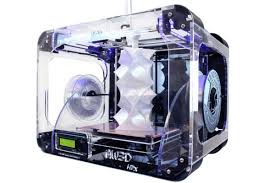
3D printing also known as additive manufacturing is any of various processes used to make a three-dimensional object. In 3D printing, additive processes are used, in which successive layers of material are laid down under computer control. These objects can be of almost any shape or geometry, and are produced from a 3D model or other electronic data source. A 3D printer is a type of industrial robot.
3D printing in the term’s original sense refers to processes that sequentially deposit material onto a powder bed with inkjet printer heads. More recently the meaning of the term has expanded to encompass a wider variety of techniques such as extrusion and sintering based processes. Technical standards generally use the term additive manufacturing for this broader sense.
3D printable models may be created with a computer aided design (CAD) package or via a 3D scanner or via a plain digital camera and photogrammetry software.
The manual modelling process of preparing geometric data for 3D computer graphics is similar to plastic arts such as sculpting. 3D scanning is a process of analyzing and collecting digital data on the shape and appearance of a real object. Based on this data, three-dimensional models of the scanned object can then be produced.
Before printing a 3D model from an STL file, it must first be examined for “manifold errors,” this step being called the “fixup.” Especially STLs that have been produced from a model obtained through 3D scanning often have many manifold errors in them that need to be fixed. Examples of manifold errors are surfaces that do not connect, or gaps in the models.
Once that’s done, the .STL file needs to be processed by a piece of software called a “slicer” which converts the model into a series of thin layers and produces a G-code file containing instructions tailored to a specific type of 3D printer (FDM printers). This G-code file can then be printed with 3D printing client software (which loads the G-code, and uses it to instruct the 3D printer during the 3D printing process).
Construction of a model with contemporary methods can take anywhere from several hours to several days, depending on the method used and the size and complexity of the model. Additive systems can typically reduce this time to a few hours, although it varies widely depending on the type of machine used and the size and number of models being produced simultaneously.
3D printers give designers and concept development teams the ability to produce parts and concept models using a desktop size printer.
FINISHING
Though the printer-produced resolution is sufficient for many applications, printing a slightly over sized version of the desired object in standard resolution and then removing material with a higher-resolution subtractive process can achieve greater precision.
Some printable polymers allow the surface finish to be smoothed and improved using chemical vapor processes.
Some additive manufacturing techniques are capable of using multiple materials in the course of constructing parts. These techniques are able to print in multiple colors and color combinations simultaneously, and would not necessarily require painting.
Some printing techniques require internal supports to be built for overhanging features during construction. These supports must be mechanically removed or dissolved upon completion of the print.
All of the commercialized metal 3-D printers involve cutting the metal component off of the metal substrate after deposition.